

- Admin
- April 20th, 2026
- 7 min Read
Cognitive Automation Explained for Modern Businesses
Digital systems generate more data and decisions than manual processes can handle. Businesses now need systems that do more than execute instructions. They need systems that understand data and support decisions.
Cognitive automation brings this capability into business operations. It combines automation with intelligence so machines can interpret information, learn from patterns, and assist in decision making.
For organizations operating at global scale, cognitive automation is becoming a core component of modern digital infrastructure. That's why Organizations are increasingly integrating cognitive automation with advanced AI powered automation solutions to manage complex digital workflows.
Cognitive automation uses artificial intelligence technologies such as machine learning, natural language processing, and data analytics to automate tasks that require human judgment. It allows systems to interpret data, learn from patterns, and make informed decisions within business workflows.
What Cognitive Automation Means in Practice
Cognitive automation refers to the use of intelligent technologies that enable software systems to analyze information and perform tasks that previously required human judgment.
Traditional automation follows fixed rules. It works well with structured data and predictable workflows. Cognitive automation goes further. It can interpret documents, understand language, recognize patterns, and make context aware decisions.
This capability is often described as cognitive process automation because it automates tasks that require thinking rather than simple execution.
Cognitive automation systems learn from historical data and improve over time. This allows businesses to process large volumes of information while maintaining accuracy and consistency.
In enterprise environments, cognitive automation is commonly used alongside robotic process automation platforms from companies like UiPath and Automation Anywhere. These platforms execute tasks while cognitive technologies interpret the information being processed.
Cognitive automation is the use of artificial intelligence technologies to automate business processes that require understanding, learning, and decision making. Unlike traditional automation that follows fixed rules, cognitive automation systems analyze structured and unstructured data, recognize patterns, and improve performance over time. Many organizations combine cognitive automation tools with robotic process automation to create cognitive process automation systems that can interpret documents, understand language, and execute complex workflows with minimal human intervention.
Technologies That Power Cognitive Automation
Cognitive automation works through a combination of artificial intelligence and automation technologies. These systems collaborate to analyze information, trigger workflows, and generate insights.
Several core technologies support this capability.
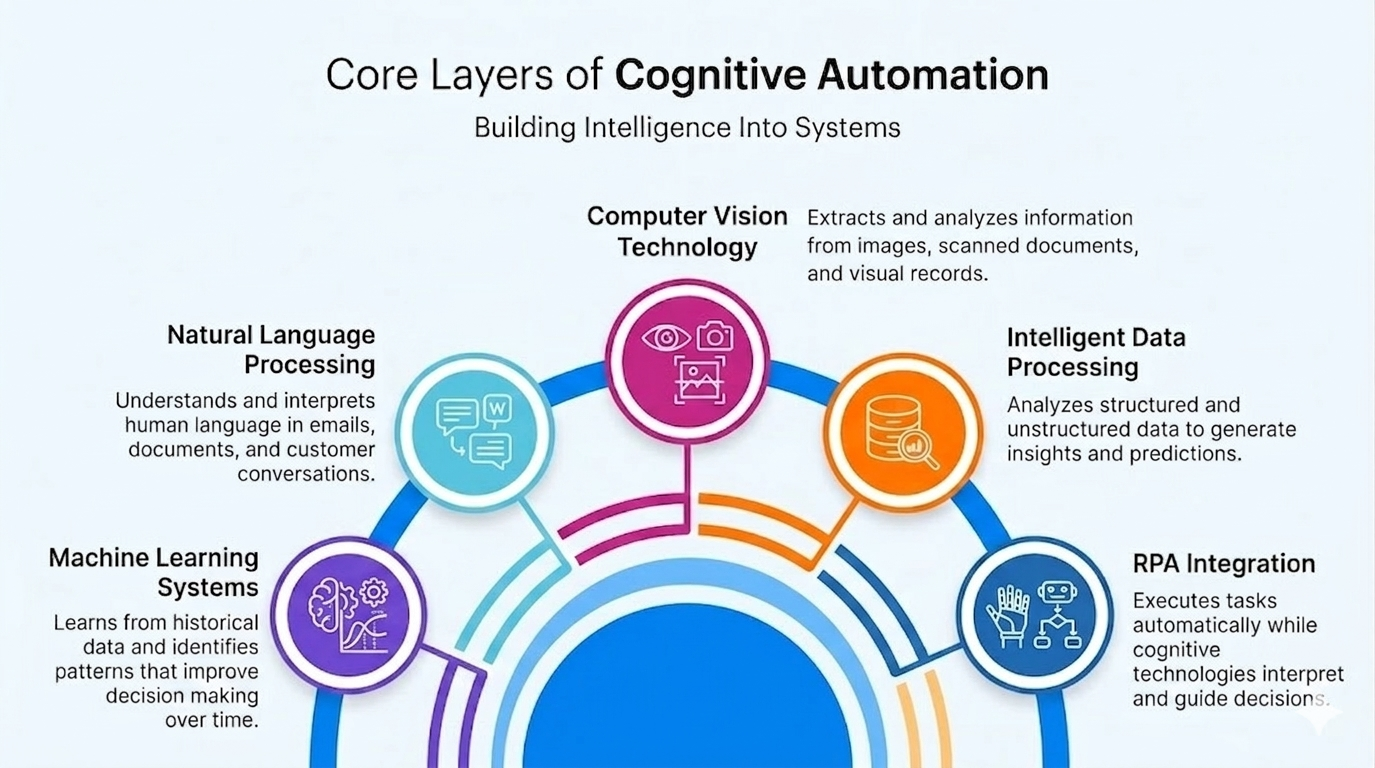
Machine learning models
Machine learning enables systems to identify patterns in large datasets. Instead of relying only on fixed rules, the system learns from historical data and improves prediction accuracy over time.
Machine learning models are often used for fraud detection, forecasting, and process optimization.
Natural language processing
Natural language processing allows systems to interpret human language in emails, documents, and customer conversations.
This technology supports automated document processing, chat systems, and intelligent search. It also allows cognitive automation tools to extract meaning from unstructured text.
Computer vision and document recognition
Computer vision systems interpret visual information from documents, images, and scanned files. This capability helps extract structured data from invoices, contracts, and forms.
Optical character recognition often works alongside this technology to convert scanned documents into machine readable data.
Data analytics and predictive intelligence
Advanced analytics systems analyze large datasets and identify correlations that are difficult to detect manually. These insights support forecasting, risk analysis, and operational planning.
Many cognitive automation tools integrate analytics engines to deliver real time insights across enterprise systems.
Robotic process automation integration
Robotic process automation executes tasks such as data entry, report generation, and system updates. When integrated with cognitive automation, these bots can process information intelligently and manage complex workflows.
Platforms like Blue Prism combine robotic automation with intelligent processing to support enterprise scale automation programs.
Why Organizations Invest in Cognitive Automation
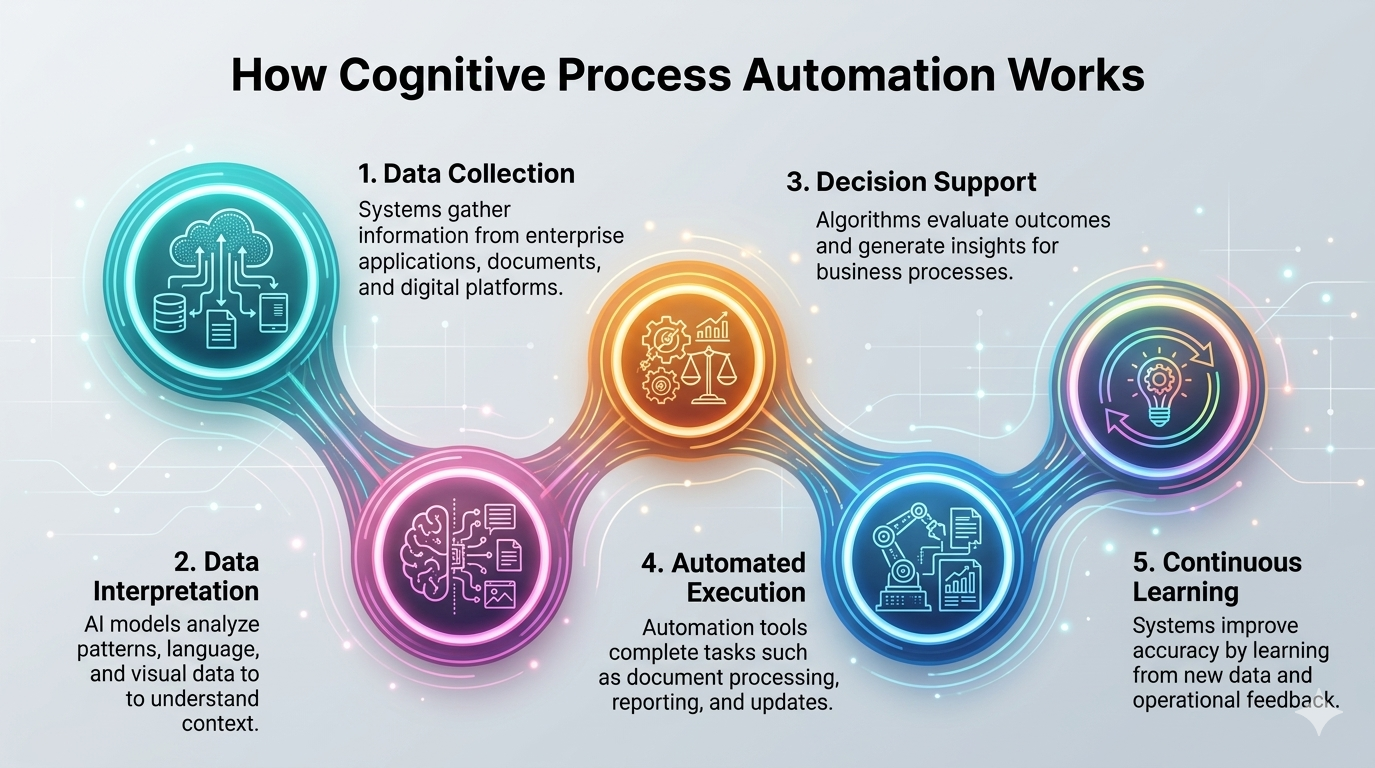
Modern Businesses are adopting cognitive process automation as part of broader enterprise automation systems to improve operational efficiency while managing increasingly complex information flows.
Several benefits explain its growing adoption across industries.
Faster and more efficient operations
Cognitive automation systems process large volumes of information quickly and consistently. Tasks that once required hours of manual effort can be completed in minutes.
This efficiency improves operational throughput and reduces processing delays.
Higher accuracy and consistent outcomes
Human processes are affected by fatigue, oversight, and inconsistent interpretation. Cognitive automation follows defined learning models and structured workflows.
As a result, organizations achieve more consistent and reliable outcomes across processes such as data entry, document review, and compliance monitoring.
Effective handling of unstructured data
A large portion of enterprise data exists in unstructured formats such as documents, emails, and images.
Cognitive automation tools interpret this data and convert it into structured information that can be used in business workflows. This capability expands automation into areas that traditional automation cannot address.
Better decision support
Cognitive systems analyze historical and real time data to generate insights that support decision making.
Instead of simply executing tasks, cognitive process automation systems can recommend actions, highlight anomalies, and support faster business responses.
Scalable operations across departments
Once deployed, cognitive automation solutions can scale across departments and regions. Processes developed for finance or customer operations can often be adapted for other functions.
This scalability allows organizations to standardize workflows and maintain operational consistency at global scale.
Understand the Wider Impact of AI on Modern Business Systems
Cognitive automation is part of a much larger shift in how organizations use intelligent technologies. Artificial intelligence is reshaping how businesses operate, make decisions, and manage digital infrastructure across industries.
To understand this broader transformation, read our detailed perspective on how AI is influencing work, innovation, and business strategy worldwide.
Explore our insights on the impact of AI on modern business systems
The Expanding Role of Cognitive Automation Tools
As digital transformation initiatives continue, cognitive automation tools are evolving rapidly. Modern platforms integrate machine learning, analytics, and automation into unified systems.
Organizations are increasingly using cognitive automation to manage complex business processes such as compliance monitoring, financial document processing, supply chain analysis, and customer experience management.
These capabilities allow enterprises to operate with greater visibility and efficiency while maintaining strong governance over critical processes.
Building Intelligent Operations with Cognitive Automation
Cognitive automation represents a shift in how businesses approach operational efficiency. Instead of relying solely on manual processes or rule based automation, organizations can build systems that understand information and support intelligent decision making.
For companies planning long term digital transformation, cognitive automation provides a foundation for scalable and data driven operations.
Organizations that invest in intelligent automation today position themselves to handle increasing complexity in global markets.
At Contrivance Softech Pvt. Ltd. we focus on helping businesses design intelligent systems that combine automation, data intelligence, and scalable software architecture.
The next step is not simply automation. The next step is building systems that can think, learn, and support better business outcomes.
Explore intelligent automation solutions with our expert Team.